In this week’s episode, both of our storytellers share tales about whales.
Part 1: As a child, Brittany Munson dreams of growing up to be a whale trainer.
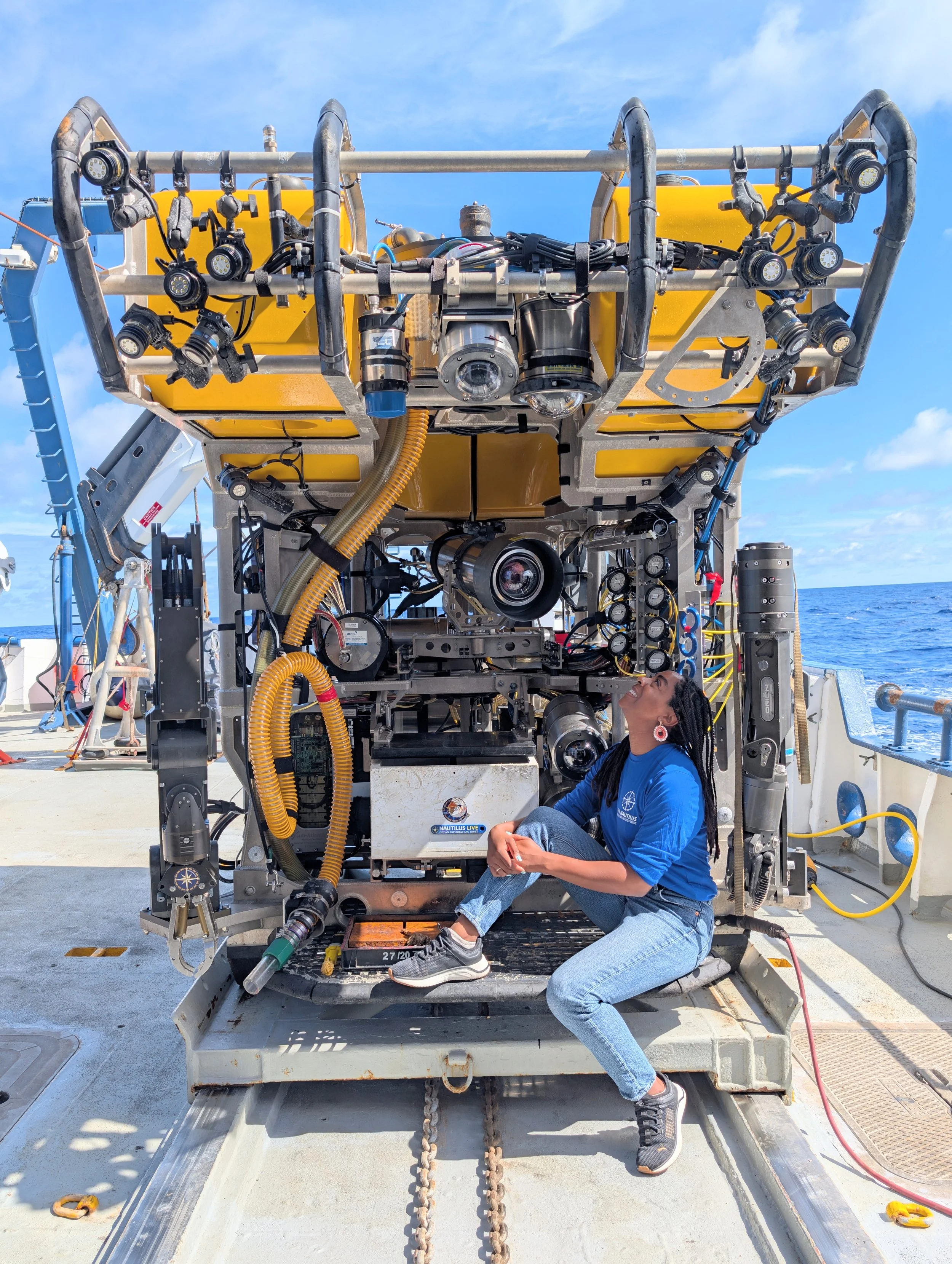
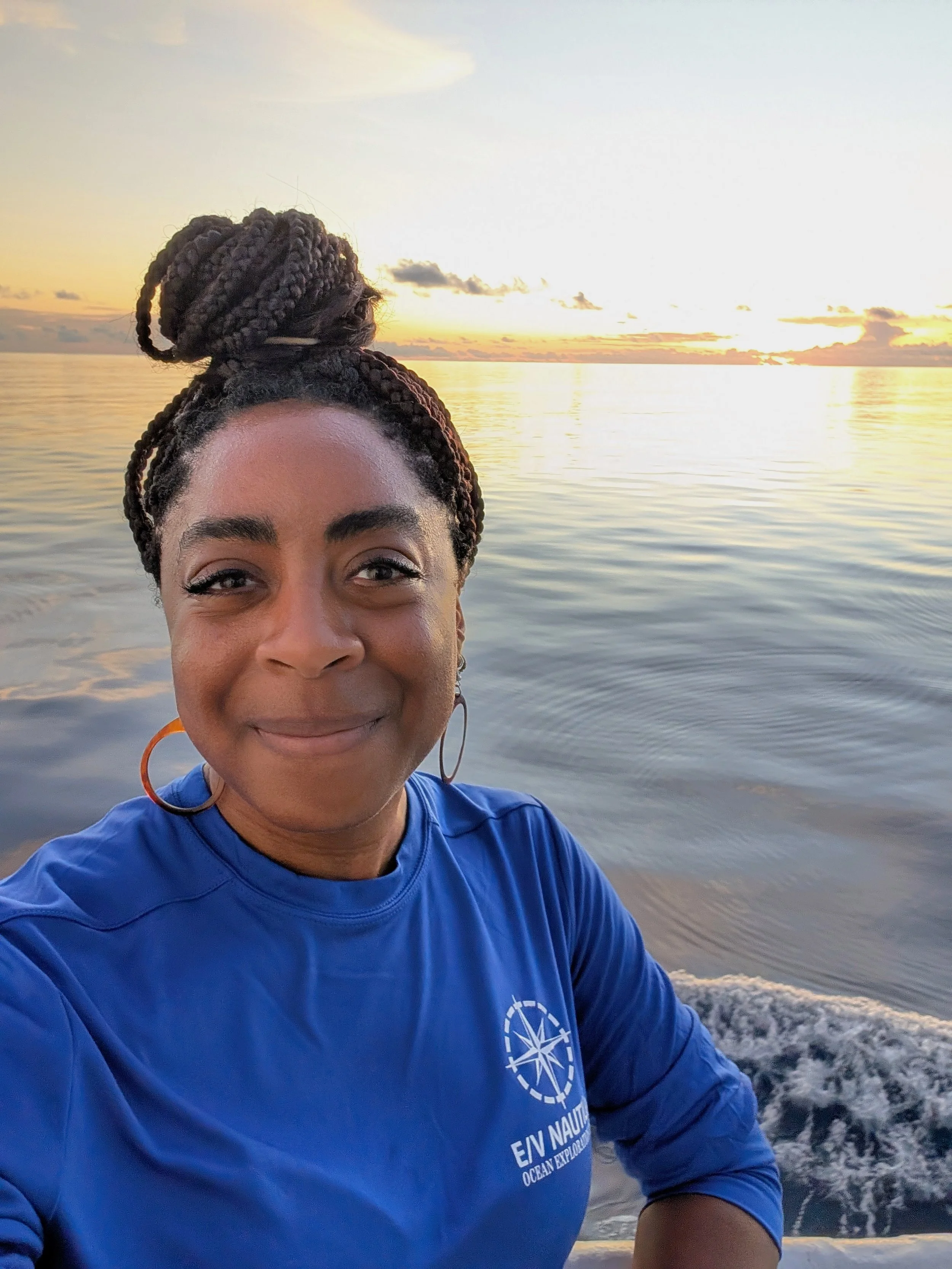
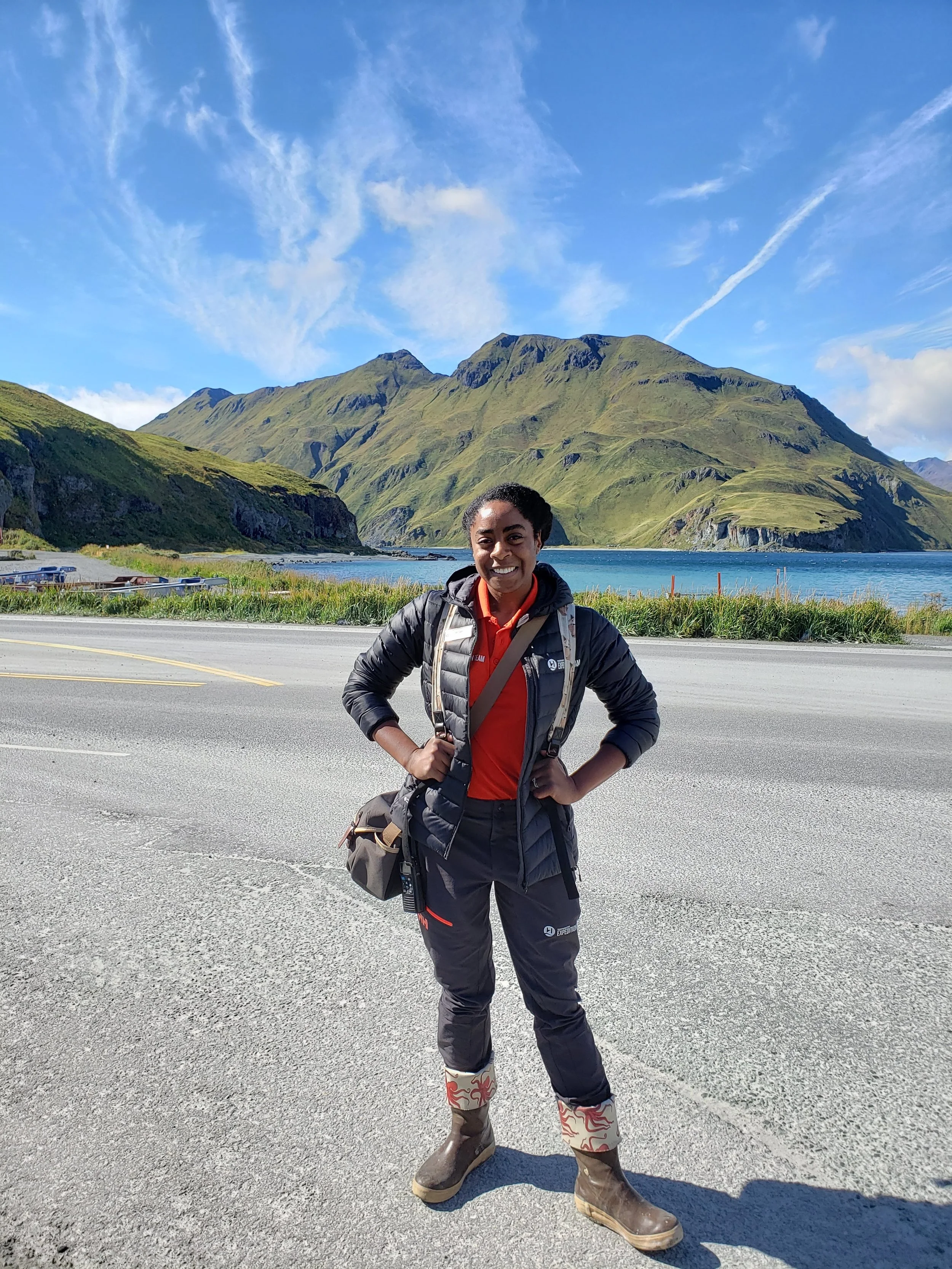
Brittany Munson is a Lead Educator at the California Science Center, where she engages public audiences in exploring various science topics and activities. With a degree in Aquatic Biology from UC Santa Barbara, she has chased her passion for the ocean from the coral reefs of the Bahamas to the icy waters of Alaska, where she spent two seasons as a naturalist. Most recently, she served as a Lead Science Communication Fellow aboard E/V Nautilus, sharing deep-sea exploration with the world in real-time. When she isn’t advocating for marine life or planning her next expedition, you can find Brittany tending to her indoor jungle as a devoted plant mom or salsa dancing on Sunday nights. She calls Long Beach home.
Part 2: As a marine scientist focused on living creatures, Maya Santangelo is convinced that diving to explore an old whaling shipwreck in the Antarctic will be boring.
Maya Santangelo is a professional nerd, diver, and marine scientist. Working in the dive and expedition industry for more than 15 years, Maya's experiences as the 2016 Australasian Rolex Scholar of the Our World Underwater Scholarship Society cemented a passion for science communication and ocean education to enhance meaningful travel experiences. Since 2017, Maya has worked as an Undersea Specialist with Lindblad Expeditions-National Geographic, diving and filming underwater around the world to share what would otherwise be out of sight, out of mind. With a focus diving in the Antarctic for the past 6 years, she has become especially interested in researching and educating about marine conservation through fisheries management and sustainable seafood choices. Alongside this role, Maya works above and below the surface to research the habitat use of the critically endangered school shark, the diet and trophic ecology of the widely distributed leopard seal, and the remote population of manta rays in French Polynesia’s Marquesas Islands.
Episode Transcript
Part 1
I press the stop button and then rewind. For a few minutes, I sit and listen as the VHS tape whirrs back to the start. Once it reaches the beginning, I press play. And, in a few moments, I'm hypnotized as I'm watching killer whales breach and frolic.
I'm about four years old, and I'm watching the movie Free Willy for the fourth time that day. My babysitter has the easiest job on the planet.
People often ask me, “What is it about killer whales? Why orcas, of all animals?” To this day, I still don't have a fully concrete answer. It has something to do with their simple yet elegant coloration, the way their eye patches hint at a facial expression, their intelligence and their mystery. Whatever it is, I can say that I've loved these animals ever since I was very, very little.
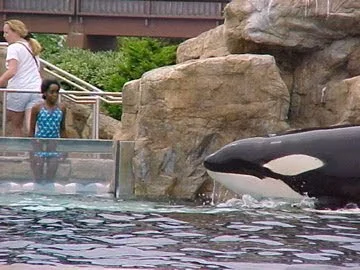
When I was about seven years old, I went to SeaWorld for the very first time, and I saw the nighttime Shamu show. It changed my life forever.
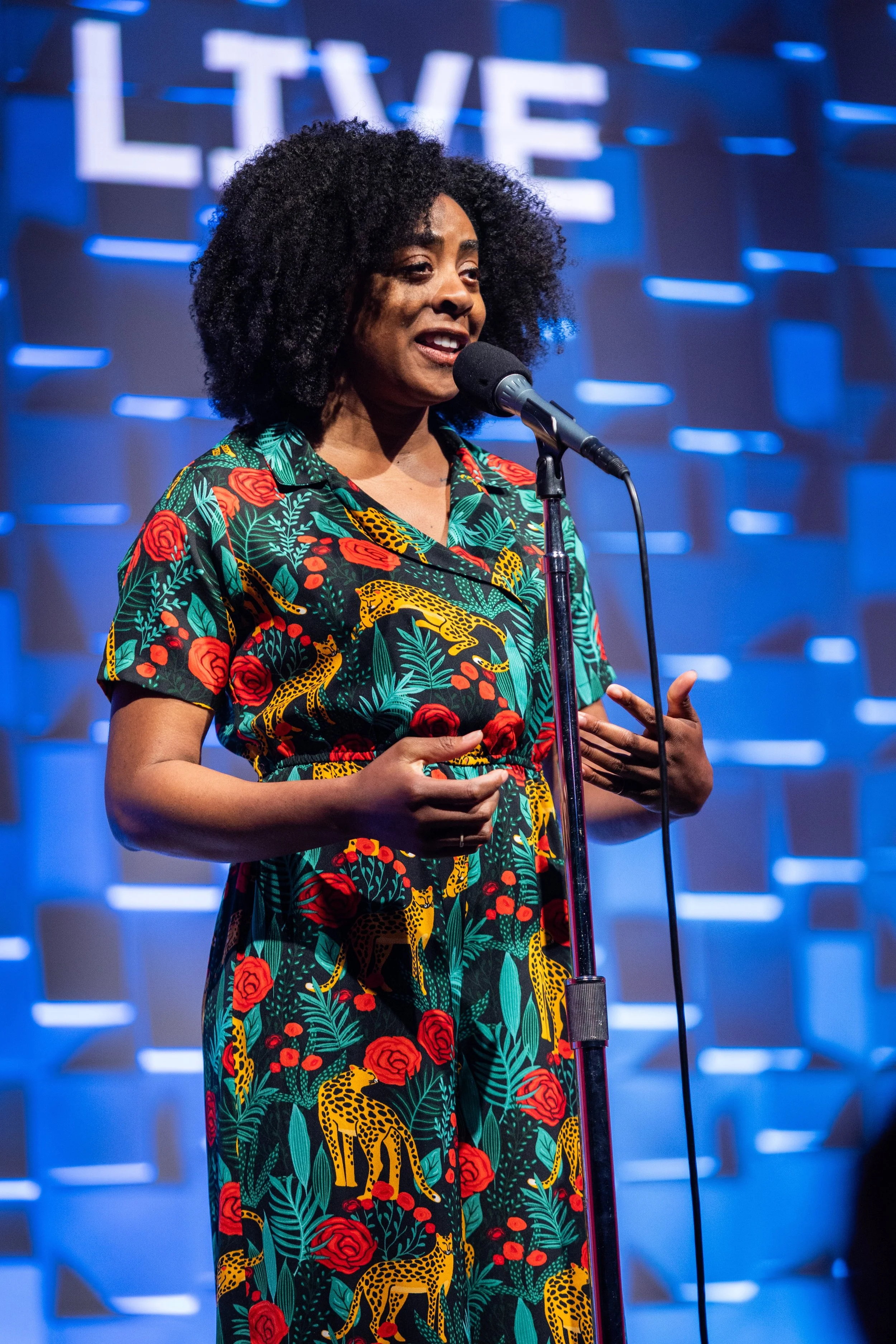
Brittany Munson performs her story at Crawford Family Forum in Los Angeles, CA in February 2026. Photo by Louis Felix for LAist.
The pool was lit in the most ethereal way. They had the most breathtaking song that was playing and it etched its way into my heart. And as I sat there watching that show, that was the moment that I knew, I just knew that I was going to grow up to be a Shamu trainer.
When I was about 12 years old, I really got to work in investigating and learning as much as I possibly could about killer whales and the Shamus of SeaWorld. And I discovered that Shamu was a stage name. When the whales were performing, they were all called Shamu, but when they weren't performing, they had their own individual names.
And so I learned all of those names. I learned how to identify each whale based on their patterns and their markings. I learned their birthdays, their personalities, their family lineages. I even found a trainer on Twitter, when that was a thing. And I remember reaching out to this trainer and asking them, “Hey, on a scale of 1 to 10, about how hard is it to become a Shamu trainer?” And their response was an 8. So I thought to myself, okay, I can do 8.
As the years went on and I was doing more and more research, I had a plan that was forming. Step one, I needed to make it to Moorpark College and get my Exotic Animal Training and Management Program certificate. Step two, I needed to make it to SeaWorld. And step three, kiss and play with Shamu for the rest of my days. All while avoiding those gross organic chemistry and physics classes, so help me God.
I had heard nothing but horror stories about those classes, how they were soul‑sucking, how it was almost impossible to pass them. So when I found out that I didn't necessarily have to take those classes to make it to Shamu, that was fine by me.
Then it was February of 2010. I was 19 years old, and I was sitting in my oceanography class when the professor broke the news to us that one of the orcas at SeaWorld Orlando had killed one of its trainers.
Silence fell in the classroom and my heart sank. It was a complete and utter tragedy. And yet, I wasn't exactly surprised that something like this happened. I had known the risks for years, but as the days went on and more details came out, I had a really hard time seeing past how SeaWorld handled the situation.
I had justified to myself for a long time that these whales were there to educate and inspire the public. They certainly educated and inspired me. But it was becoming apparent that perhaps the entertainment the whales were providing was starting to overshadow their need for respect and well‑being. And so with my eyes opened, I had to pivot.
I wrestled with myself for weeks, bargaining with my soul to see if there was any way that I could hold on to what my childhood dreams promised me. But I knew deep down I wasn't going to be able to separate my values from my work, and so I let go.
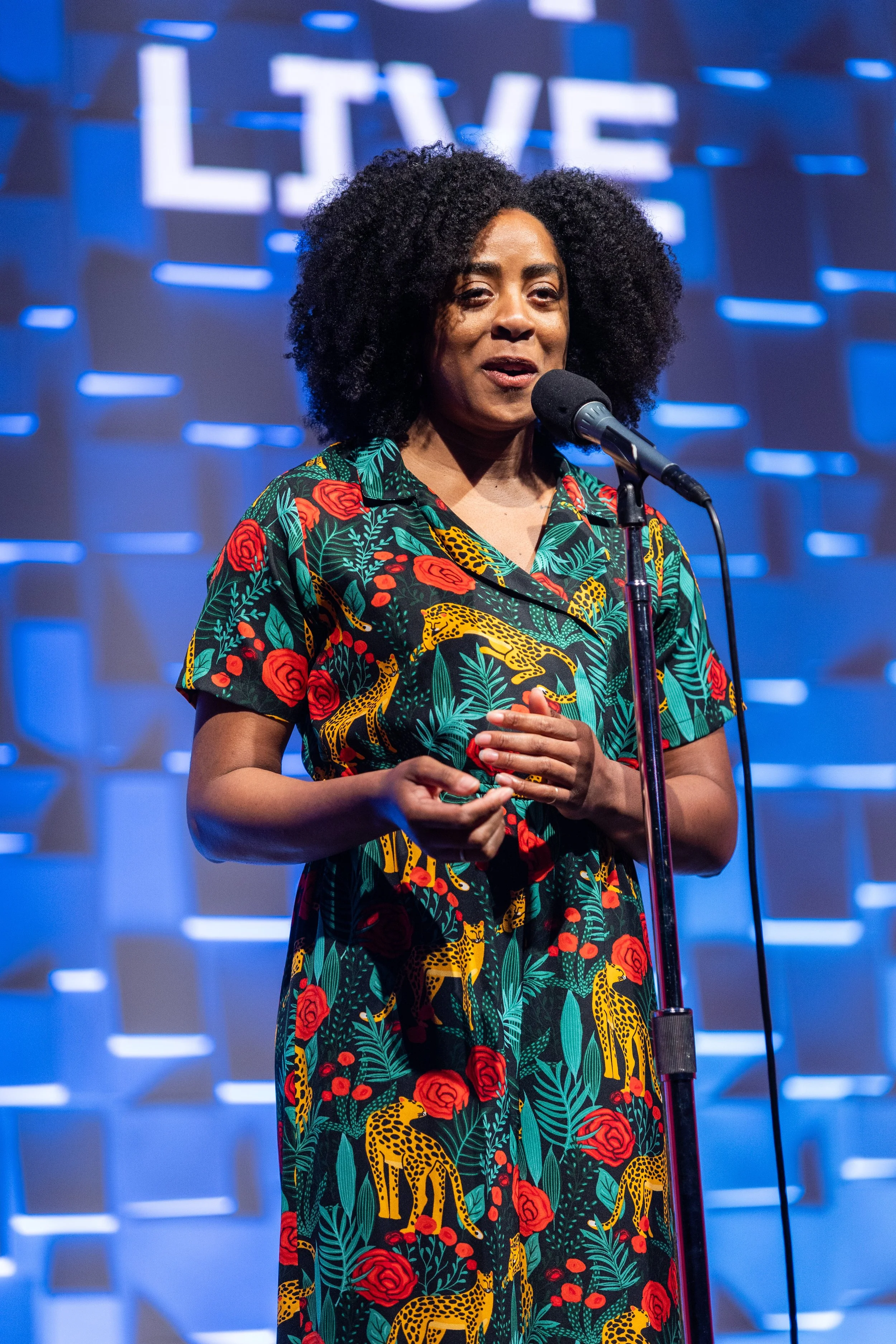
Brittany Munson performs her story at Crawford Family Forum in Los Angeles, CA in February 2026. Photo by Louis Felix for LAist.
It was the hardest thing I had ever had to face at that time in my life. What was I? Who was I if I wasn't going to be a Shamu trainer? That had been my future identity ever since I was seven. And now I was 19 and I was staring ahead at my question mark‑shaped future with a sinking feeling.
I took some time to reflect and see what I could do next. I decided that I would see what would happen if I did get my degree in marine biology. So I leaned in and I took the gross organic chemistry classes and I took the gross physics classes.
A few years later, I emerged from the University of California, Santa Barbara, with my Bachelor's of Science degree in aquatic biology. Upon graduation, people asked me, “Are you going to go back to school, and where do you want to end up?” My response to them was, “Probably not,” and, “I don't know.”
I took some time to explore internships, and on my journeys, I saw countless species of whales. I saw humpback whales, blue whales, even beluga whales. But my eyes were always scanning the horizon, searching for those elusive creatures of my dreams. As many times as I had been out to sea, I still had yet to see a killer whale in its natural environment.
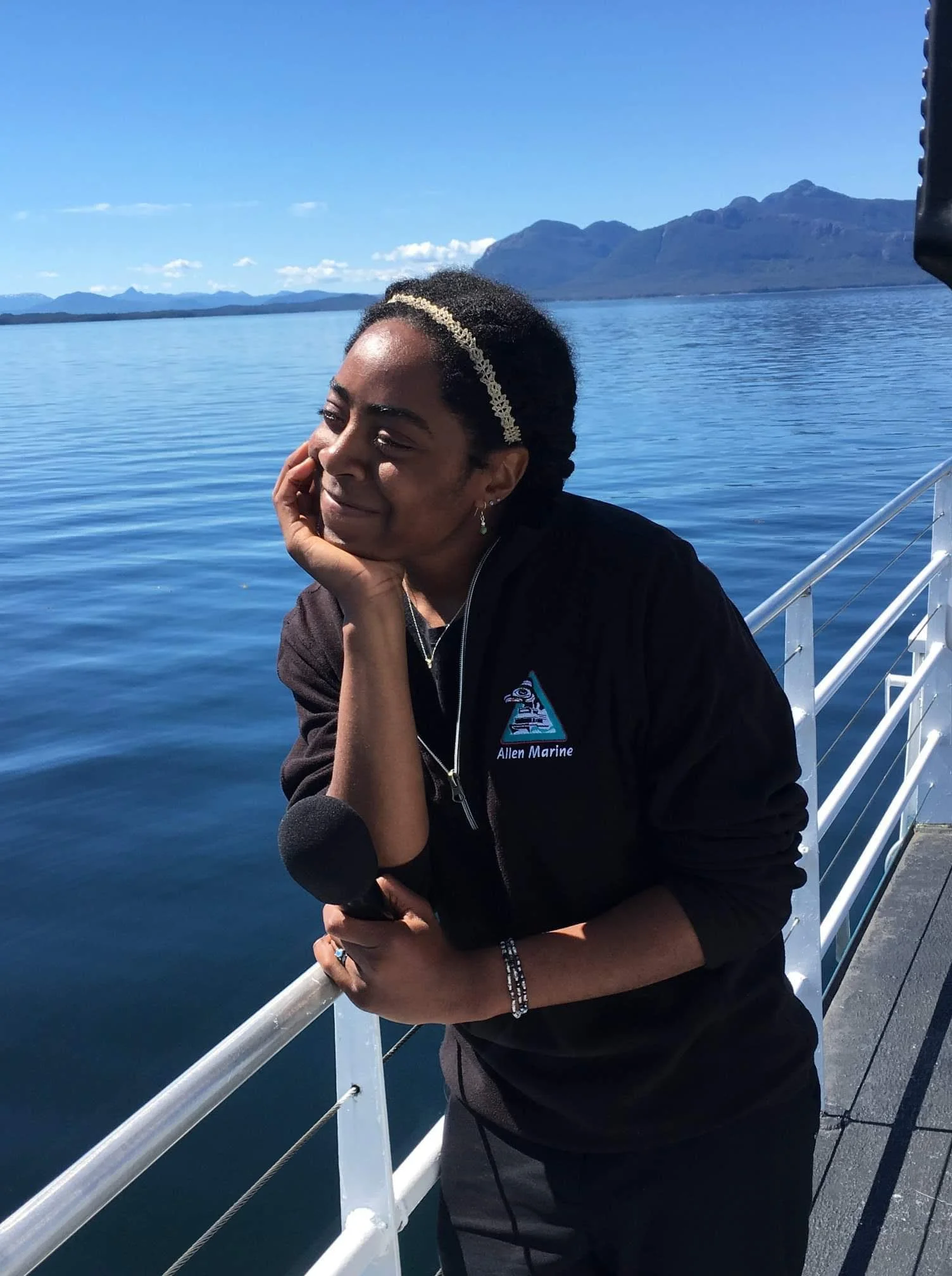
Eventually, I ended up in Ketchikan, Alaska, working as a naturalist for Allen Marine Tours. I remember the only question I asked my interviewer was, “How often do you see killer whales in that area?”
The date was May 12, 2018. I was sailing on the Sea Otter Express with Captain Tony, and we had about 20 guests on our boat. I was using my binoculars to scan for wildlife, looking for eagles in the trees, looking for any deer that could be grazing along the shoreline, and of course scanning the waters for any activity there. Then I start to see something way, way out in the distance, some splashes, some disturbances in the water.
So I call up Captain Tony, “Hey, Tony. Way, way out there about the 10:00 position, just off the shore of Annette Island, I think I see something.”
There's silence for a moment, and Tony replies, “Yeah. All right, I see it. We're going to head over.” Click. Okay.
So I pick up my microphone, I hop on, and I let our guests know, “Hey, we think we see something. We don't know quite what it is yet, but we're going to go check it out. Just keep your eyes peeled.”
So the Sea Otter Express gets closer and closer to this zone of activity, and I see it. A big black fin slices through the calm Alaskan Sea. And another, and another, and I'm looking at the fins of killer whales.
I gasp, and I don't know whether or not I should laugh or cry. Both of my hands end up over my heart as I'm staring at these creatures utterly in disbelief that my dream is coming true. And they are starting to make their way closer to our boat to swim alongside us.
By now, my guests have noticed that their naturalist hasn't said anything for quite some time. She's not really moving much, so they're looking at me with some concern. I'm finally able to break out of it and find the words and share with them exactly how much this moment means to me. And I can see their facial expressions start to shift and soften as the realization sinks in.
Then I tell them facts about the whales. All of the documentaries, the textbooks, the encyclopedias I had devoured throughout the years came to life through my narration. The book my mom gave me when I was a kid, the lecture I attended when I was a teenager, they pieced together beautifully in this moment.
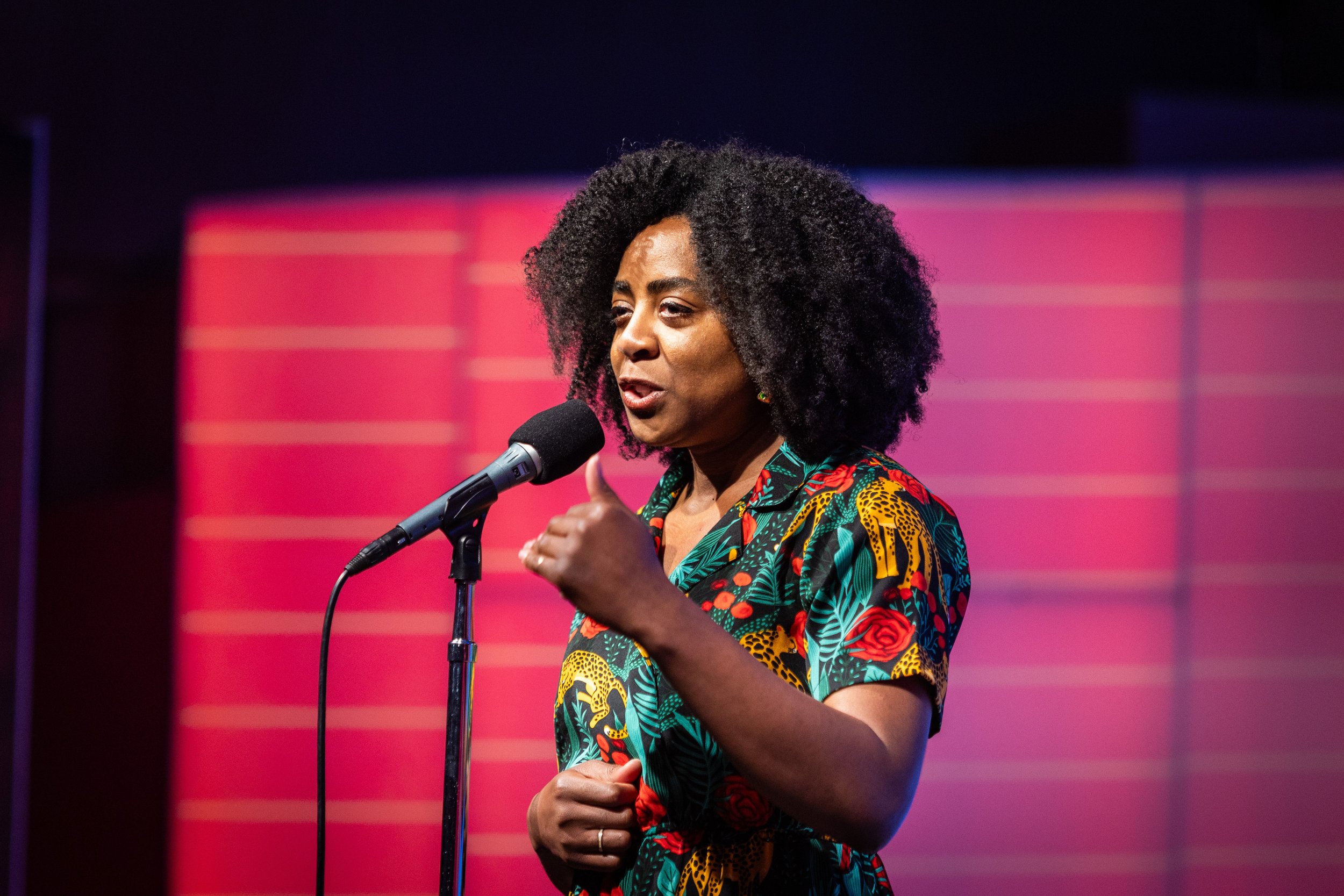
Brittany Munson performs her story at Crawford Family Forum in Los Angeles, CA in February 2026. Photo by Louis Felix for LAist.
The whales stayed with us for a few minutes before they decided that they were going to depart and swim out to sea. As I watched them swim away, I was just left in awe. It finally happened. I saw them, they were beautiful, and they were free. With one final tail slap, they disappeared beneath the waves, and they never knew the dream they fulfilled that day.
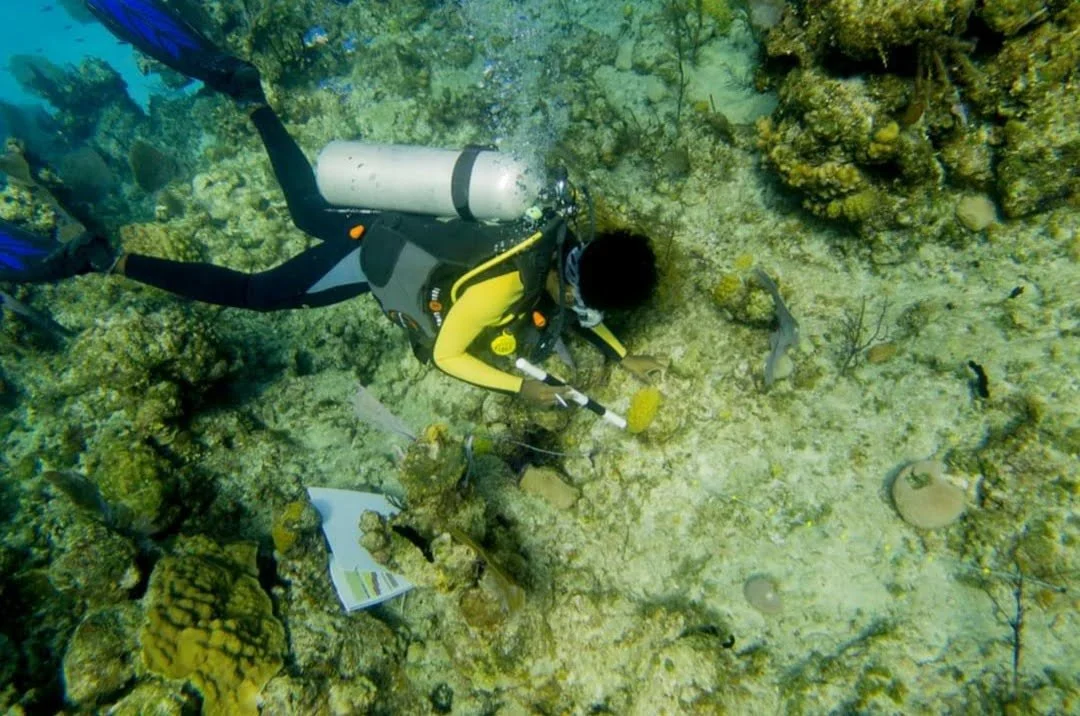
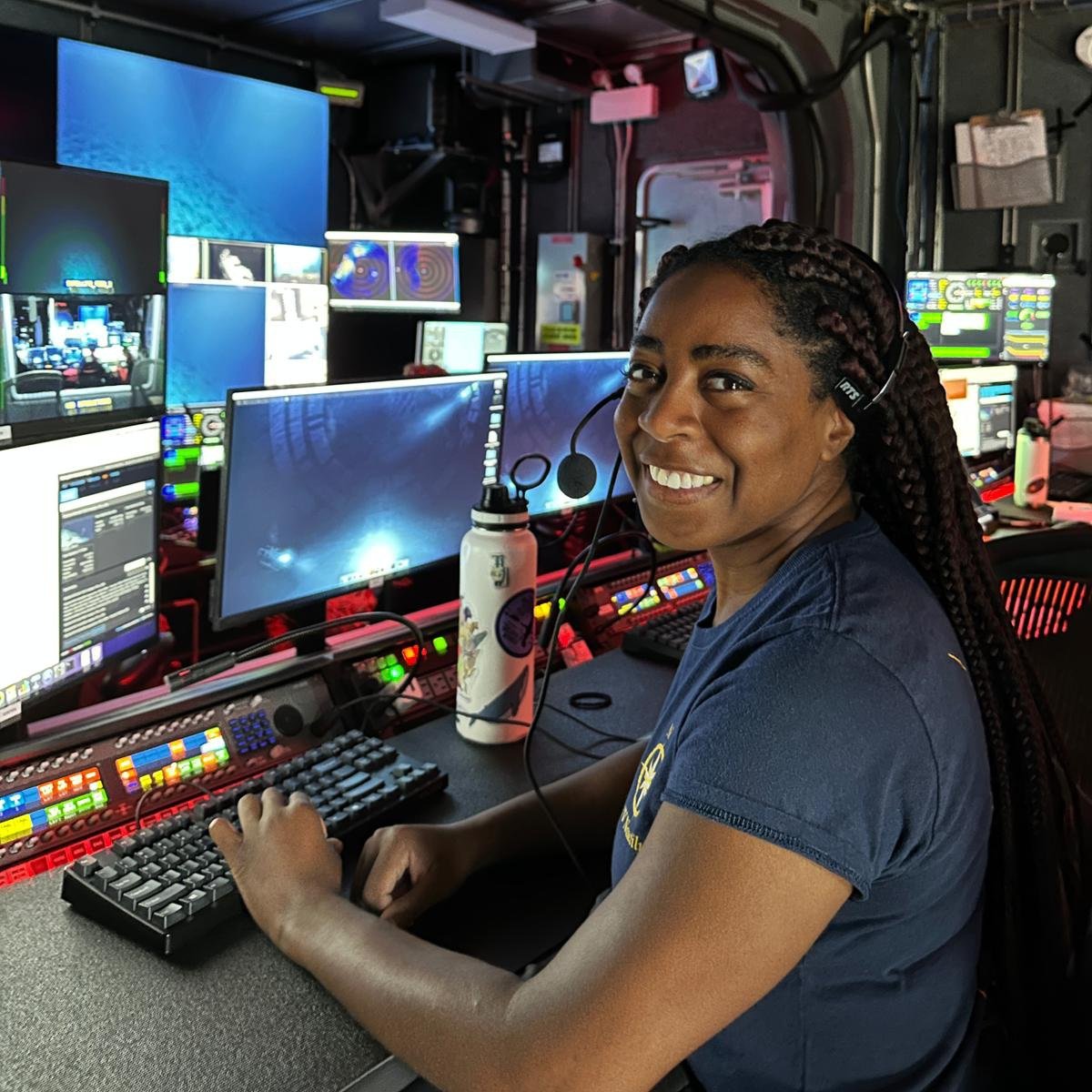
I never did become a Shamu trainer, and I don't think I ever will, but if I could go back in time and have a chat with my childhood self in the minutes that passed as she rewound Free Willy for the fifth time that day, I think that she would be ecstatic about her journey. I would tell her how she's sailed on EV Nautilus, exploring with scientists who are making groundbreaking discoveries about the deep sea. I would tell her how she's been scuba diving in the Great Barrier Reef and has aided in coral reef restoration efforts in the Bahamas. How she's sailed through the Bering Sea. How her name appears in the credits of an IMAX film about blue whales. How she has traveled the world and has shared her experience and her passion with a global audience. And yeah, she's even seen killer whales in the wild multiple times.
Today, people continue to ask me, “Are you going to go back to school,” and, “Where do you want to end up?” My response to them today is still, “Probably not,” and, “I don't know.” And I'm proud of that answer. Today, more than ever, I know that we may not end up where we expect to be, but if we do follow our passions, we will always end up where we need to be.
Thank you.
Part 2
It's January 2019 and I'm off to an awesome start to the year because I'm working in Antarctica. This is something I never thought I would get to do. When I started diving 13 years before, I thought that my only option for a career in scuba diving was to join the military and then I would never see another fish again. But here I am working on a tourist expedition ship as the undersea specialist where my job is to dive and film and share stories of what would otherwise be out of sight and out of mind.
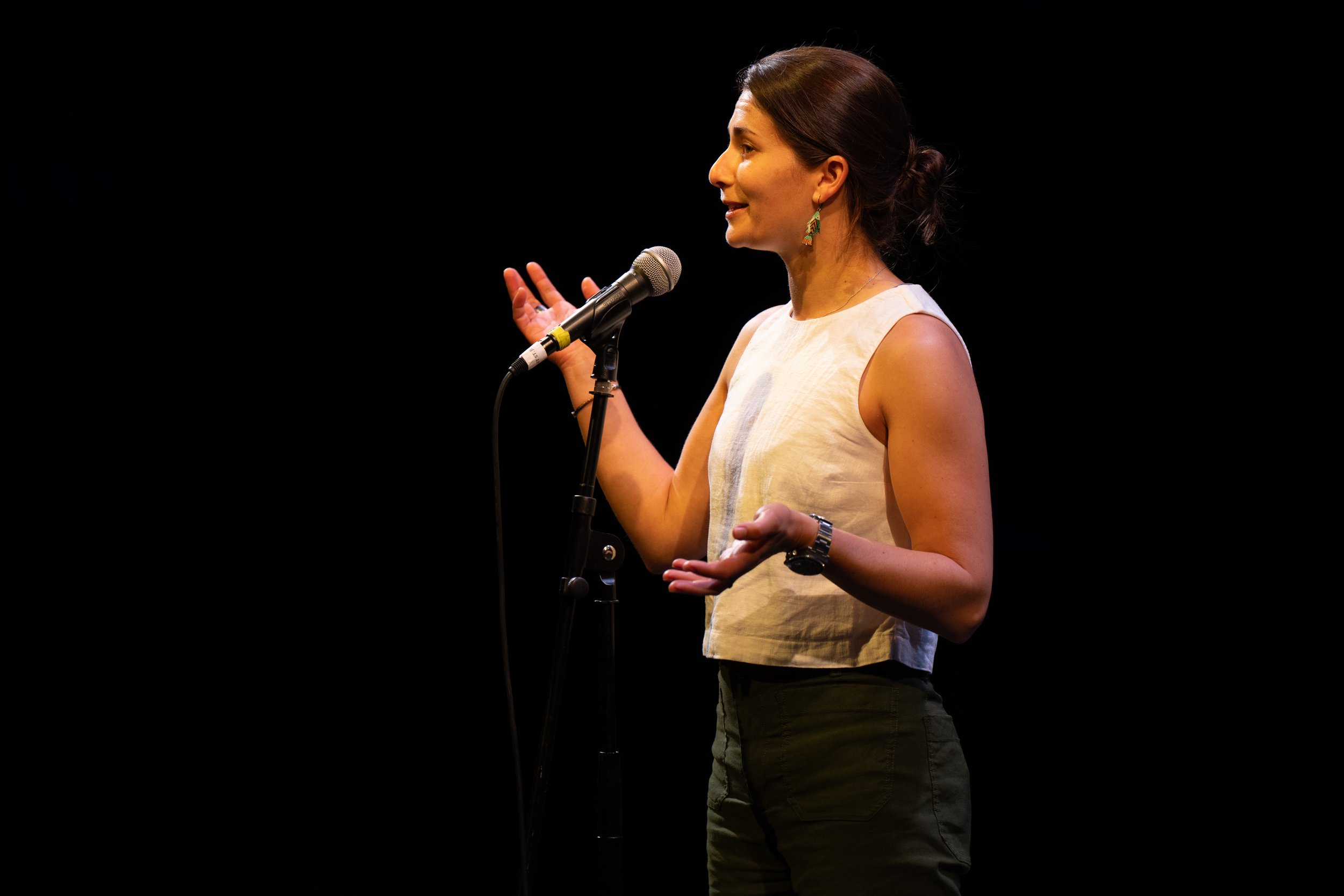
Maya Santangelo shares her story at The Theater at St. Jeans in New York, NY at a show we did in partnership with Our World Underwater Scholarship Society in June 2024. Photo by Zhen Qin.
When most people come on a trip to Antarctica, marine invertebrates like sponges aren't usually on their list of things that they want to see and they don't usually expect there to be much living in really cold water at all. So getting to be the person that voluntarily throws themselves into the coldest water on the planet to show people all the weird and wonderful life that exists below the surface is character building, but very rewarding and brings me so much joy.
I had just started another trip down to the Antarctic Peninsula and just met my expedition leader. And he says, “Hey, I know this great site that I highly recommend that you dive at, and I will make sure that the ship is in the area so that you can do it.”
“Great. What's the site?”
He's like, “It's a wreck of an old whaling ship.”
To any history buffs in the room, please forgive me for this next part. I said, “I'm not really interested in wrecks.”
He's like, “No, trust me. You should really do this dive.”
I didn't want to shut him down, but my gut reaction was just that this wasn't my ideal dive, not just because I'm a huge nerd that has always been more interested in marine life than human history, but because for the job that I do, where the purpose of my dives is to create video presentations to educate people about how amazing and important life in the ocean is, I just didn't see this shipwreck as the best dive for that.
On top of that, when you're diving in the coldest water on the planet where you're usually getting ready for twice as long as you're actually going to be in the water for, sometimes when you're going to all that effort, you kind of want it to be worth it.
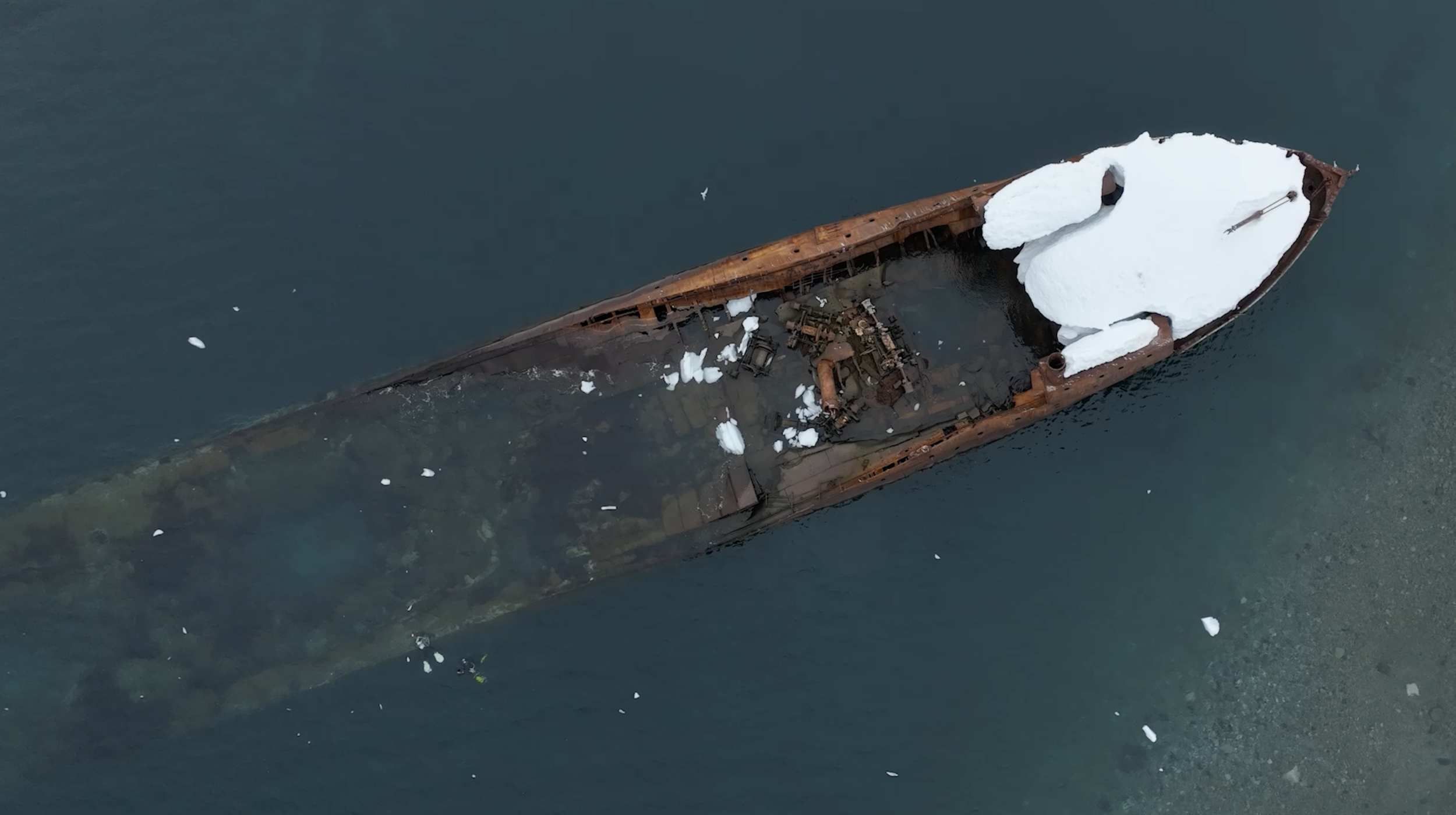
So anyway, we get to the area where the dive is in, and my buddy and I get ready for this dive. All our thermals, gloves, socks, heated vests, all marshmallow packed under our dry suits, and of course our cameras. We load all the gear in the Zodiac and head out from the ship, and we start to approach this small protected cove and can start to see it. It's the Guvernøren, a wreck of a Norwegian whaling vessel that sunk in 1915.
Above the surface, we can just see the bow of the ship, maybe about a quarter of the wreck sticking out of the water, and it's been taken over by a nesting colony of Antarctic terns. Apart from their squawking, we're surrounded by this beautiful icy coastline and it's perfectly calm.
I don't really know what to expect, so decide to start the dive right about where the wreck meets the water and go from there. And we start to descend and swim out and swim out along the top of the deck and I can start to appreciate how big this wreck is. The deck is about 15 meters across and the length of it extends far beyond what I can see away into the depths.
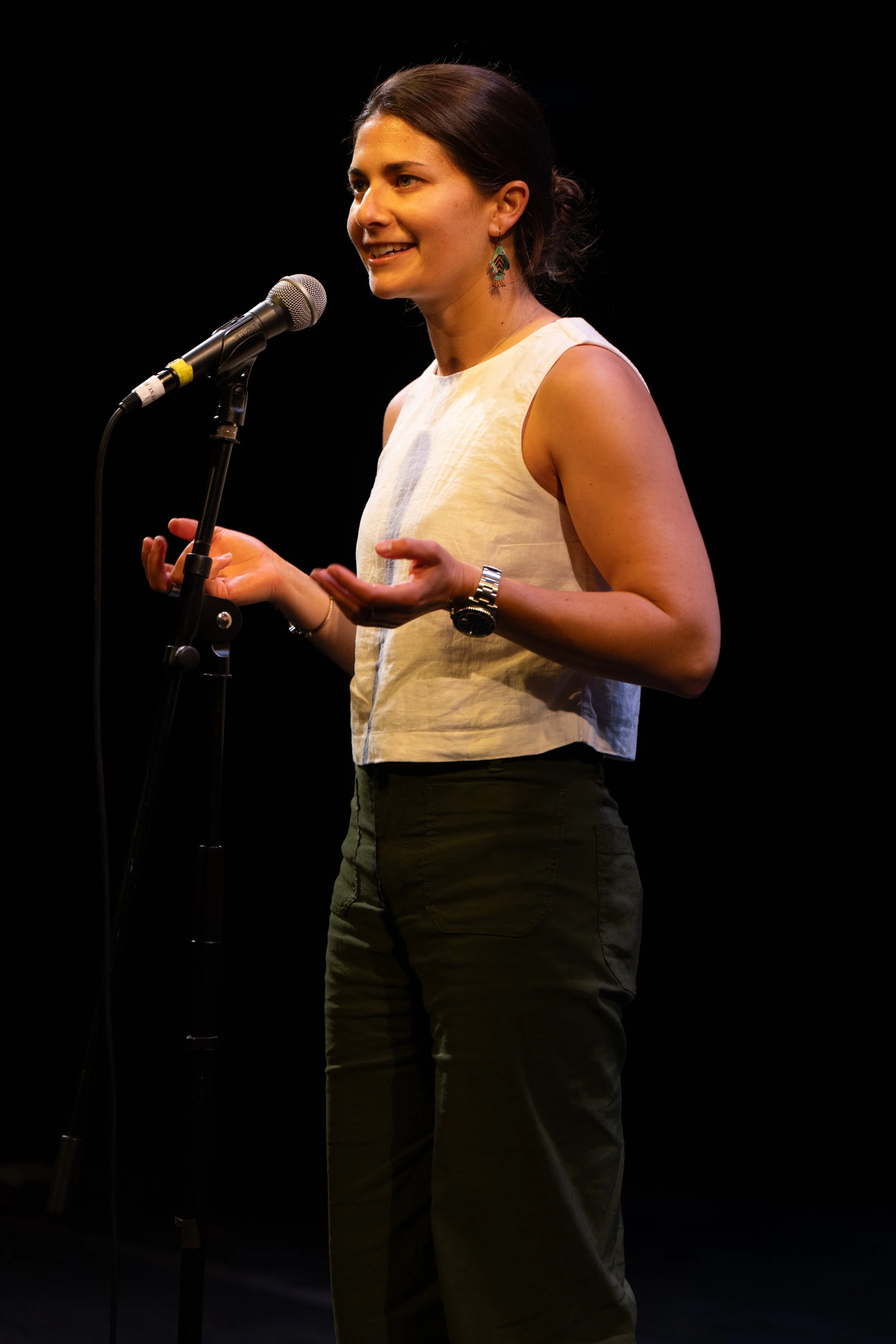
Maya Santangelo shares her story at The Theater at St. Jeans in New York, NY at a show we did in partnership with Our World Underwater Scholarship Society in June 2024. Photo by Zhen Qin.
This wreck is massive. And apart from being sunk, it's pretty well intact and preserved by the sub‑freezing water that it's in. So we can see all the wooden and steel structure of the ship itself, as well as all the equipment that was used in the industry that it was part of. There's these huge, huge boilers the size of a car that were used for rendering whales into oil.
I also come across this big opening, big square opening into a hold in the deck. And when I lower myself down into it, my video lights, I can see that there are these wooden barrels filled with whale oil stuck floating up on the underside of the deck.
So it's a bit eerie and definitely not a dive that I'm used to, but I'm realizing and appreciating how unique this experience is to get to collect images and share stories of what was clearly once a very important whaling factory ship. So I'm on this dive, I'm like, “Okay, this dive is pretty cool.”
But I also find it interesting that I haven't found much marine life yet, so I kind of want to keep exploring around. I finally pick a spot to swim up and over the sides of the deck and you get this real sense of going over the edge and into the unknown.
So I'm following down the steep sides of the hole down to where the ship meets the sea floor, and my video lights are illuminating the scene in front of me. And I let out this very scuba style audible exhale of realization and excitement, “Mmm!” We all know the one. We've all done it.
On one hand, I'm thinking, “Ah, yes, I’ve found it.” And on the other hand, I'm thinking, “Ah, yes, it makes perfect sense.”
What I'm looking at on the sides of and all around the base of the wreck is, by far, the greatest concentration of marine life I have ever seen anywhere underwater in Antarctica. And I'm laughing at myself because it makes perfect sense that this wreck would be where you would find it. Because in Antarctica the environment is so defined by ice and that persists underwater as well. Because the mass of an iceberg, up to 90% of it, is below the surface, icebergs physically scour and bulldoze the seafloor habitats and that limits what life can persist at shallow depths. So anytime you have a vertical substrate, like a rock wall or, in this case, a shipwreck, that's where you find the most life. But this is way more than I ever thought I would find in a place like this.
I'm now at the stern end of the ship and this part of the wreck is literally bursting at the seams with life. There are beautiful bright orange colonies of leaf‑like bryozoans and huge groups of bright red brachiopods and big tunicates the size of footballs. And every overhanging surface of this wreck is covered in these massive, magnificent chandeliers of yellow sponges.
And among all these encrusting filter feeders, there's big, bright pink anemones, bigger than a dinner plate, big bread loaves of white nudibranchs and fat sea stars everywhere. It's the most incredible covering of diverse, colorful life that, honestly, rivals any tropical coral reef I have ever seen.
So this dive is blowing my mind and I'm filming all the life as it spills over from the surface of the wreck out onto the rocky slope that it's resting on. It starts to thin out towards the sedimenty sea floor. And I start to see it. At first, it's just small pieces here and there, like breadcrumbs leading me away from the shipwreck. And it starts to get bigger and bigger and more and more. It's extending, just like the wreck did, far beyond to the distance away from what I can see.
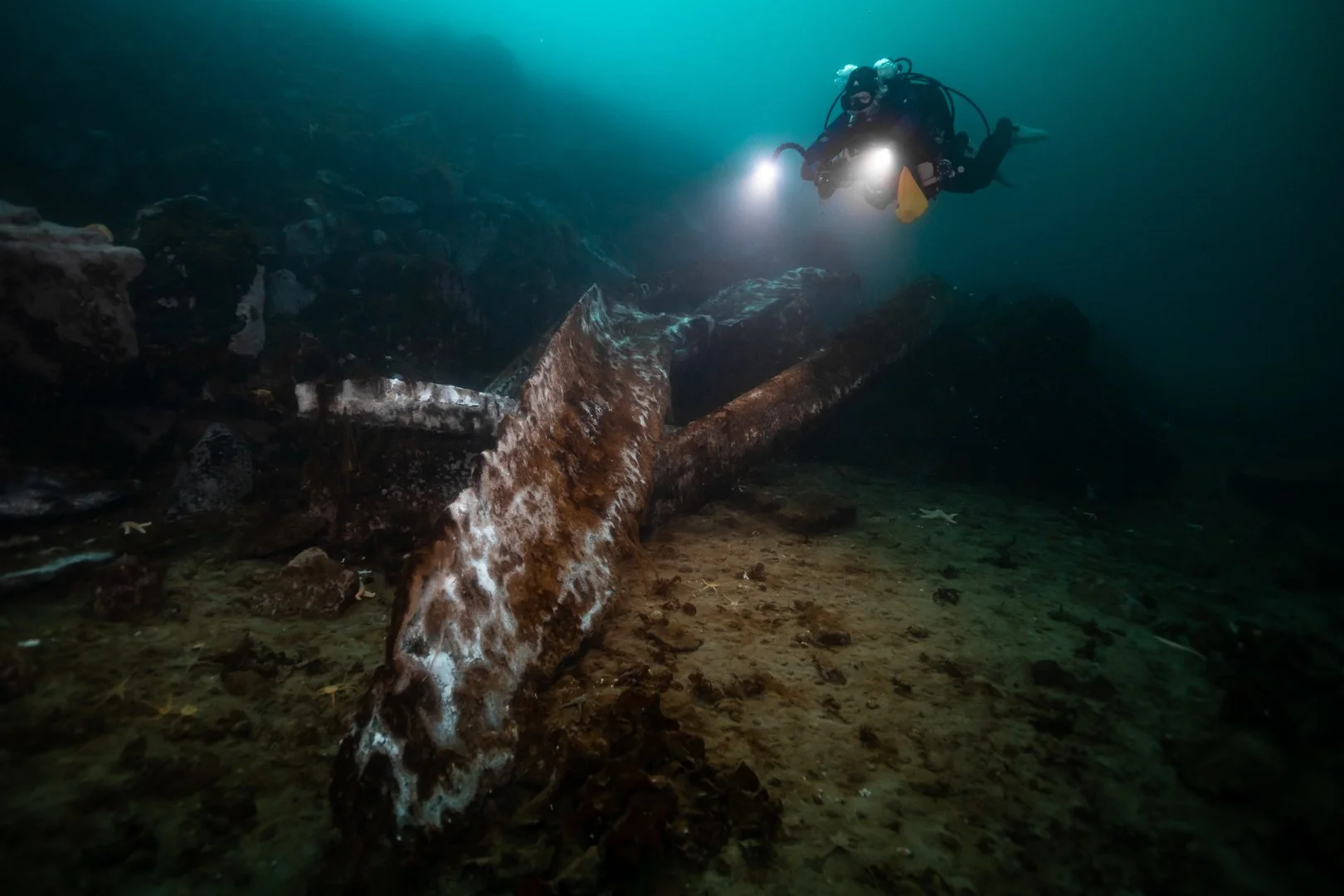
This time, the sound that I exhale from my regulator is this quiet, “Oh, my God.” Because what I'm looking at is what I can only describe as an elephant graveyard of the bones of blue and fin whales, the largest animals that have ever existed on this planet. And again, it makes perfect sense because of where I am.
The Guvernøren is wrecked within Foyn Harbor of the Enterprise Islands. Svend Foyn was the inventor of the exploding harpoon, and he brought whaling down to Antarctica. The islands are named for the enterprise of the whaling industry. So when the ship caught on fire, the captain ran it aground in this location because the protected nature of the cove made it well used for bringing in whale catches and processing the whales alongside the ships. And at the time, that involved discarding what was left of the whales once they had been stripped of their blubber.
I'm swimming along this endless pile of enormous 100‑plus‑year‑old skeletons and I can feel my face getting hot underneath my mask, which is a strange sensation when you're diving in minus two degree water and your face went numb 30 seconds into the dive. But my face is getting hot because I want to cry. It's the most impactful dive I have ever done and, honestly, one of the most humbling experiences of my life to get to see this. And the way it made me feel the first time I saw it is the way it makes me feel every single time I dive here.
Most days that I get to work in Antarctica, I am so lucky to get to see humpback whales. And they're a species that have been estimated to recover to pre‑whaling numbers. What's funny about this dive, actually, is that the area it's in isn't a typical spot that we usually go to for our typical expedition activities. It's not right next to a penguin colony like a lot of our other dives. So to do this dive, the ship has to go out of its way to let us do it and, to justify it, they'll hang nearby just a couple hundred meters away and they'll pass the time by watching humpback whales feeding all around the ship while we're underwater, just over there, filming the remains of the industry that once almost wiped these animals off the face of the planet.
So it's pretty hard to put into words the contrast of these experiences but they're pretty perfect examples to remind us of what life in the ocean is capable of if we just give it the chance. So when we think about something like whaling, it might make us think, “Wow, that was horrible.” But look how far we've come and look at the progress that we've made.
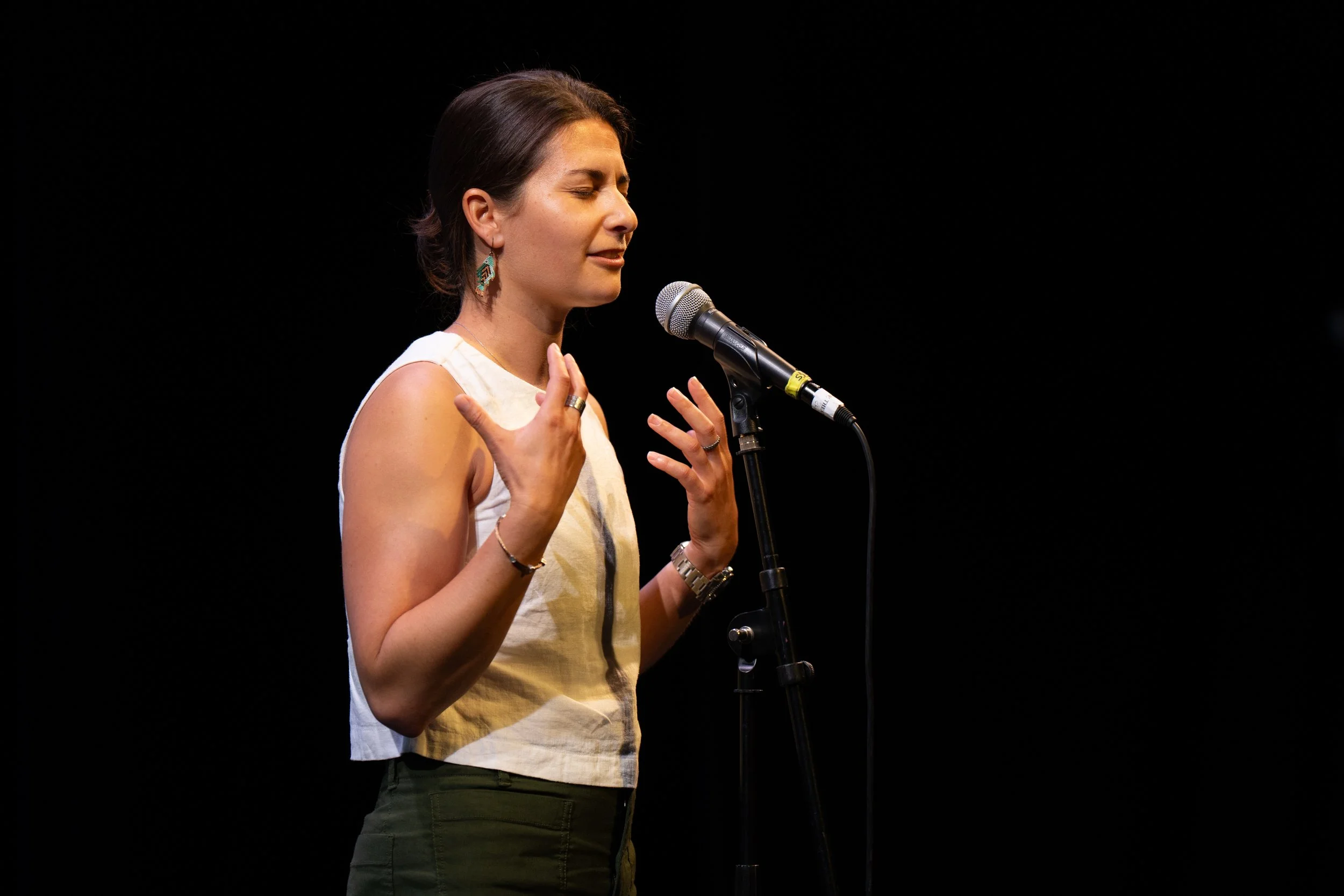
Maya Santangelo shares her story at The Theater at St. Jeans in New York, NY at a show we did in partnership with Our World Underwater Scholarship Society in June 2024. Photo by Zhen Qin.
But when I dive here and see the elephant graveyard of whale bones, it makes me wonder not when but if we will ever get to a point where we will feel that same way about how we currently treat the planet. Or in 100 years, are we going to look back and wonder why we didn't do more?
It started as a dive that I had no interest in doing because I thought it was going to be a boring shipwreck that didn't offer me any educational stories to share with people. And now every time I start a trip to Antarctica, I meet up with the expedition leader and captain and say, “I'm not trying to be high maintenance, but can I please do this dive?”
It's not just my favorite dive because it has the most incredible marine life I've ever seen underwater in Antarctica, or because it made me cry, but because it gives me the best story to tell, to remind others and myself that there is still so much more to save and we have the ability to do just that.
Thank you.